Monday, April 28, 2008

Fam Flight

Well, a simulated Fam flight.

I've been really curious about the training aircraft the Navy fly around here. I've got Microsoft Flight Simulator X, so I decided to hunt around for some download-able versions of the planes we see here all the time. While the only T-34 I could find was the old B-model (piston, not T-prop), I did find a quite excellent version of the T-6 Texan II's that are used for training at NAS Pensacola. And... it even brings an NAS Pensacola skin for Training Air Wing Six (TAW-6)!

I also found some scenery for NAS Pensacola itself. It's pretty darn good and includes the Blue Angels hangar, Naval Aviation Museum, and other landmarks. It provides a lot more detail than the stock FSX "generic airport". Cool stuff.

So I loaded up, spooled her up, and went tooling around my neck of the woods.

The NAS Pensacola ramp, with the Blues parked in the background.


"Negative Ghostrider, the pattern is full."
The NAS Pensacola complex.
Practicing an approach at Pensacola Regional.
Screaming over the waves at 270 knots.

One of the reasons I downloaded the plane was to see where certain avionics are, like the transponders, navigation receivers, and radios. This gives me a better idea of what the pilot himself is doing in the cockpit.

Friday, April 25, 2008

"Are you Declaring an Emergency?"

"Affirmative."

Today was the first time I'd ever heard that over my own headset.

I'd been working the usual arrival and departure T-34 traffic into NAS Whiting. Then I get this call on the radio.

"Pensacola Approach, Shooter 123 Solo. I'm returning from [Training] Area 2 and I've got a problem with my landing gear. It's stuck down and my speed's restricted. I'd like to get vectors back to Whiting."

Now, T-34s being 40 year old airplanes, it's not unheard of for one of them to have a gear issue. Normally they'll just fly their inbound routes like usual, with the only difference being that they'll fly much slower (120 knots vs. 190) so as to not damage the gear. However, I've only seen that done with an instructor on board. In this case, it was a solo student pilot, and I could tell by his voice that he was a little spooked.

I calmly acknowledge his transmission and issue him a squawk code. Usually it takes around 30 seconds to a minute for the pilot to punch in the squawk code, our radar to process it, and the datablock appear on our scope. However, I notice it's taking an unusually long time. I know that Training Area 2 is to the north, but I don't see him anywhere near where the T-34s are usually calling in.

Me: "SH123, say position?"
SH123: "SH123 is... uhhh....right near the power lines and south of the sawmill..."
That of course doesn't help me a bit. It was evident that he was looking at a detailed sectional chart, while our radar maps really only show obstructions, sector boundaries, and airports.
Me: "SH123, where are you in relation to Brewton [Airport] or Point Initial [Inbound Fix]?"
Both of those are a couple fixes in the northern part of our airspace that are known to all the Navy pilots since they use them for training.
SH123: "Uh, I'm about 5 miles east of Evergreen [airport]."
The lightbulb goes on. I know exactly where he is. I increase the range of my scope by 20 miles and see him wayyy out there by Evergreen airport, which is a little field the T-34s go to practice their training. Funny enough, I took a look at the sectional chart when I got home last night and saw the power lines he was talking about.

Now, Evergreen is about 10-15 miles past our airspace boundary inside Jacksonville Center's airspace. I can't legally radar identify him without getting a point-out approved from the Center. I key up the Crestview Low sector for ZJX.
Me: "Crestview Low, Pensacola Whiting, Point Out."
ZJX: "Crestview."
Me: "Point out, 5 miles east of Evergreen, squawking 1234. T-34 VFR inbound to Whiting."
ZJX: "Point out approved."

That gives me the green light to work him in the center's airspace. I reset my scope back to its normal range, but shift the view northbound a bit so I can keep track of SH123 as he comes in.

Me: "SH123, radar contact 5 miles east of Evergreen."
SH123: "SH123, roger, radar contact."

I can hear the relief in his voice. At this point, we usually ask the pilot if they require any assistance or emergency handling. My instructor keys up.

My instructor: "SH123, are you declaring an emergency?"
SH123: "SH123, affirmative."

Now, if there was a flight instructor on board, he probably would not have declared an emergency. The other "gear-down" T-34s I've worked have been dual training flights with both an instructor and student aboard. But being a solo pilot in an unusual situation, I think he did the right thing. There's no such thing as being "too careful" when your airplane's not working right, especially when you're an inexperienced student.

So, now it's officially an emergency. If you know the 7110.65, you know there's several things that we need from the pilot. Most of it has already been answered in this case, both within the pilot's first transmission and by the fact that we're familiar with the Navy trainers' equipment and aircraft.
10-2-1. INFORMATION REQUIREMENTS
a. Start assistance as soon as enough information has been obtained upon which to act. Information requirements will vary, depending on the existing situation. Minimum required information for inflight emergencies is:
  1. Aircraft identification and type. SH123. By his squadron (Shooter) and callsign, we know he's a T-34.
  2. Nature of the emergency. Gear stuck down.
  3. Pilot's desires. Wants radar vectors back to Whiting.
b. After initiating action, obtain the following items or any other pertinent information from the pilot or aircraft operator, as necessary:
  1. Aircraft altitude. His mode-C is indicating 4500 feet.
  2. Fuel remaining in time. Unknown.
  3. Pilot reported weather. VFR, but other aircraft along his route of flight were indicating that the ceilings were dropping.
  4. Pilot capability for IFR flight. All of the Navy pilots are IFR rated. It's one of their pre-requisites prior to training in the T-34.
  5. Time and place of last known position. He's radar contact on my scope.
  6. Heading since last known position. I can see him tracking southwest-bound.
  7. Airspeed. He's already told us his speed is reduced and I see that his groundspeed is 120 knots.
  8. Navigation equipment capability. The T-34s generally have GPS and VOR/TACAN.
  9. NAVAID signals received. Unknown.
  10. Visible landmarks. He'd indicated his position near Evergreen airport.
  11. Aircraft color. T-34s are orange and white, the standard Navy training colors.
  12. Number of people on board. He'd called himself a "solo", so just one.
  13. Point of departure and destination. Departed Whiting. Went to Evergreen. Returning to Whiting.
  14. Emergency equipment on board. Unknown.
Considering that the pilot was VFR, had reported no weather difficulties, and was navigating via visual references, the only question I really had for him was how much fuel he had left.

Me: "How many hours of fuel do you have remaining?"
SH123: "Errr... two hours."

In the meantime, my instructor has called the supervisor over. He also calls Whiting tower, giving them a heads up on the inbound emergency, including nature of the emergency and the fact that he was a solo. This gives them time to prepare the crash trucks and whatever else they need to do.

Now it's time to get SH123 back home. I type a * on my ARTS keyboard, click on SH123's target, and then click on the VFR arrival fix (Point Charlie) for Whiting, which is about 5 miles out from the runway threshold. It reads back about a 200 heading and about 35 miles flying distance. I take a look at our current wind - out of the southeast and moderate - and do a quick mental calculation.
Me: "SH123, fly heading 190. Vectors to Point Charlie."
SH123: "Roger, heading 190 for SH123."

While this is going on, I continue to work my other traffic. I keep an eye out on SH123 as he slowly makes his way in. To my surprise, the vector I gave him puts him directly over Point Charlie. I had expected to have to give him some tweaks, but it worked out fine. I give myself a silent "w00t!" and switch him to tower after he calls the fix in sight.

SH123 was plugging away at 120 knots his whole way in. Behind him are two more Navy T-34s about 7 miles apart, cruising towards the airport at about 190 knots. Rather than reduce their speed or give them delay vectors when they're 20 miles from the airport, I let them keep coming most of the way to see how things work out. When the first one is about 3 miles behind SH123, I go ahead and give him a right 360 for spacing. My instructor also reminds me to issue the second one a 360 just in case he closes the distance. I tell them both the reason: "A solo T-34 with an emergency." That lets them know I'm not just spinning them for my own amusement.

While those two were burning circles in the sky, I watch SH123 on his straight-in approach. As he descends below our radar's vertical range, his target drops off my scope and goes into coast track. After waiting for a minute or so, I call the tower to ask if he got down okay. "He juuuust landed." was the eager reply, and I tell my supervisor and instructor so my sup could log the event. "Can I send the other guys in?" I ask the tower. "Sure, bring 'em in." I get the other two back on course and switched them to tower.

And that was that. The planes keep calling and I keep working. The traffic doesn't stop just because another plane's in trouble, though pilots will be more accommodating when they hear someone in trouble on the radio.

The unexpected end to this happened when the land line from the tower rings a few minutes later. I pick it up. "This is the Whiting sup. Is this the controller?" "Errr, yes?" I reply, wondering what I'd screwed up. He continues, "Hey, listen, I just want to thank you for helping us out with that emergency. Also, holding those other guys out gave us plenty of space to work with him and get him on the ground. Good job." I wasn't expecting anything like that. "Hey, no problem at all. Anytime," I replied and unkeyed the line.

The sup's comments definitely lit up my day, although I didn't (and still don't) think I'd done anything special. Handling emergencies and such are part of the job description. The experience served as a good reminder of the basic purpose of ATC: controllers working together to keep people safe. I know for a fact any other controller here at my facility or anywhere else in the country would have handled that situation the same way. It's just part of the job.

In the grand scheme of things, a student pilot with his gear stuck down is not exactly a major emergency - unlike an engine fire, a fuel emergency, or landing gear stuck up. If there's such a thing as a "starter emergency" this was definitely it! However, it allowed me to get acquainted with the overall procedures involved in emergencies such as:
  • Taking care of the distressed pilot's needs.
  • Notification of the supervisor.
  • Notification of the tower.
  • Coordinating with other facilities.
  • Gathering information from the pilot.
  • Working other aircraft around the emergency.
  • Keeping your voice calm and reassuring to a distressed pilot.
Good experience. One more tool in that ever-growing toolbox.

Thursday, April 17, 2008

Training Updates

There hasn't been all that much to report on the training front. I'm still working on the NAS Whiting sectors. I've been recommended for certification on two radar positions by two different instructors, however my supervisor wants all of the trainees to get a bit more experience with IFR/Marginal VFR operations.

The problem with our facility is that we handle so much Navy traffic and work so many specialized Navy procedures that the standard civilian stuff tends to fade a bit. For instance, two weeks ago was the first time I'd ever released an IFR aircraft out of an uncontrolled field while another IFR aircraft was inbound to that field. This of course required me to hold the inbound somewhere until the departing aircraft got airborne. I'd studied this kind of thing and it ended up being simple to work. I'd just never actually seen it in nearly six months of steady training.

What is becoming readily apparent is that there's simply no way to train you for every eventuality. Every day you work, you see something that you've never seen before. You work it, talk about it with your instructor, and put it away in your experience "toolbox". As you progress that toolbox continues to fill until you've got quite a few tools that you can call into action at a moment's notice.

The powers-that-be realize that you may not have seen every feasible scenario in the world. They just want to know that your judgment is sound and that you have enough experience to handle most scenarios safely. You of course have to be thoroughly versed on your airspace, your letters of agreement, and your operating procedures. Working knowledge of the 7110.65 as it relates to your facility is imperative as well. All that goes a long way to establishing a solid comfort level.

One thing that's been told to me repeatedly: even after you're checked out, you are absolutely encouraged to ask questions on stuff that you're not sure about. Most of the controllers I work with have no problem at all answering questions regarding all of the above. No matter how stupid the question may seem, you should get it answered.

Wednesday, April 16, 2008

The Art of War (As Applied to ATC)

I recently picked up a copy of Sun Tzu's The Art of War at my local Barnes and Nobles. As a student of military history, it's always intrigued me from afar. I took the plunge and I must say that I'm glad I did.

The book is a collection of statements, all of which are divided into eleven different chapters such as "Laying Plans", "Maneuvering", and "Variation of Tactics". To put it simply, it's a For Dummies guide on waging war, covering topics such as tactical advantages of terrain, financing military campaigns, maintaining troop morale, surprise, and deception. It's remarkable how relevant this man's treatise is thousands of years after it was written. Whether it's the D-Day beaches of WWII or the sands of modern-day Iraq, the majority of the piece remains thoroughly applicable.

What's even more remarkable to me is how much of it applies to the "art" that is air traffic control. As I read the verses, I couldn't help but notice the appropriateness of the material.


Sun Tzu Wrote:
The art of war teaches us to rely not on the likelihood of the enemy's not coming, but on our own readiness to receive him; not on the chance of his not attacking, but rather on the fact that we have made our position unavailable.
- VIII, verse 11
In short: be prepared, come whatever may. When you sit down at your radar scope or stand up in your tower you need to be on your game and ready for anything. Whether you end up working two planes or two hundred is irrelevant; the important thing is to be prepared for two hundred and keep your edge sharp. If you go in thinking the session's going to be a cakewalk, you'll be on the wrong side of the power curve when the unexpected storm of traffic hits.

This not only applies to attitude, but technical preparedness as well. Do you know your airspace? Your approaches? How about your Letters of Agreement? How fresh are the Standard Operating Procedures in your mind? These are all "weapons" that you need to have at the ready, on call at an instant's notice for application.

Before I go on, I'd also like to emphasize that I do not view pilots as the "enemy". However, like an opponent, they present unpredictable situations that need to be dealt with using grand strategy, local tactics, planning, and speed. If not handled properly, they will cause harm - either to themselves, your career as a controller, or both.
He who exercises no forethought but makes light of his opponents is sure to be captured by them.
- IX, verse 41
It's your job to look ahead and prevent situations. Say you've got two airplanes on your scope that are forty miles apart but whose paths cross. You take a glance at it and blow it off, thinking "Eh, they'll never hit." You know, the old betting on the come routine. Minutes later your luck runs out, the CA-CA goes off and you're taking a CA-CA of your own in your pants. You should have prevented that, either with an altitude change or some other means.

Be proactive. Don't just solve problems but step up and keep them from ever forming. You need to look into the future, whether it's one minute or twenty. If you're only thinking about the present, you're already far behind.
Success in warfare is gained by carefully accommodating ourselves to the enemy's purpose.
- XII, verse 60
This is a twofold statement. First you must determine the pilot's intentions. This can be divided up into two additional levels: near-term and long-term. For instance, in the near-term this pilot wants to do several approaches at your airport. The long-term plan after the approaches is for the pilot to depart VFR to the north and get flight following to a neighboring city.

Secondly, you take this information and incorporate it into our "big picture". You plan how you're going to insert this aircraft into your approach pattern along with the other aircraft you're working. You also determine how the aircraft will eventually depart northbound, factoring in elements such as airspace and traffic flow. While the pilot conducts his approaches, you reassess constantly to verify that your plan will in fact work. If there are doubts or issues, you reformulate your plan on the fly to make it work.

In short, be flexible and responsive. Do not become so attached to a plan that you tie your own hands behind your back.
If, however, you are indulgent, but unable to make your authority felt; kind-hearted, but unable to enforce your commands; and incapable, moreover of quelling disorder: then your soldiers must be likened to spoilt children.
- X, verse 26
Your job title says "controller" in it, so take control. If you're sheepish on the radio, pilots will jump all over you like a pack of ravenous wolves. Confidence in your voice and your instructions will leave zero doubt of who's control on the frequency.

This is especially important when you're busy and reaching your operational limits. You don't have time to deal with questions. You simply need pilots to comply, and comply now.

Additionally, you are supposed to provide the pilots as much service as you can, but not at the expense of order and safety. There just comes a point where you cannot provide optional services to them any longer. If that pilot is requesting one more practice approach and you've already got a pattern full, "Unable additional practice approaches. Say intentions." The tone and firmness in your voice will dissuade them from questioning your authority.

The facts are:
  1. Sometimes you just need to come off like an arrogant (but G-rated phraseology-compliant) jerk in order to get the job done right. "Stern parent voice" works nicely.
  2. Not every pilot is going to get what they want all the time.
  3. Do not accommodate optional pilot requests to the point where safety and separation are lost.
  4. Pilots will whine and question if given the opportunity. Do not waver.
Old Truths Ring True Today

The 7110.65 is the quintessential source for Air Traffic procedures and regulations. Its hundreds of pages are full of dry phraseology and methods that lay down the rules but do little for the nuances of the job.

When it comes to the strategy, personality and mentality of ATC, there are plenty of sources from which you can draw inspiration. First and foremost are the controllers who have been doing this for twenty years and are full of techniques and tricks. That "tribal knowledge" is an irreplaceable, invaluable resource that helps us new trainees determine what we need to focus on during our length training process.

Outside of their vast experience, you can find comparative works in the strangest of places. The Art of War is such a perfect piece because its subject matter shares considerable similarities to ATC. Timing, tactics, overall strategies, proactive maneuvers, priorities of duty: these are all things that come into play every time you plug-in.

I highly recommend the book, whether you're into:
  • Air Traffic Control
  • Military history and tactics
  • Or... actually, you know, planning to invade a small country.
If it's the latter, I recommend Monaco to start. With a land area of only .76 square miles, it should be a pushover. I hear the beaches are choice. :)

Sunday, March 23, 2008

A Bit of a Bender

Ok, that last video is a pushover. They just flew over the road at low level. My dad just sent me one that beats it into the dust... literally.

What about taking off from a jungle road? In a regional airliner? In Africa's Congo? In the daytime performance-killing jungle heat and humidity? Surrounded by trees so close they can smack your wings?

Still too easy? I might add that this road-turned-runway has a 45 degree bend in it.

The airplane being flown is a Czech twin-turboprop LET-410. It can carry up to 19 passengers or 3.5 tons of cargo and is widely valued for its performance in "unprepared fields". I believe a curving road in the middle of the African jungle qualifies as an "unprepared field". :)

Note: the airplane graveyard off to the left as he lifts off into the air. Looks like an Antonov An-2 Colt biplane and some other Eastern Bloc aircraft met their ends there. That's ironic, since the An-2 is widely considered a "classic" STOL aircraft. The manual doesn't even state an actual stall speed.

Tuesday, March 18, 2008

Only in Russia

Pick up the FAA's Federal Aviation Regulations and Airman's Information Manual. When you look through those hefty binders, you'll see page after page telling you "Don't do this" and "Don't do that." All those boring paragraphs telling you keep 500 feet away from all people and 1000 feet above populated areas, or big bad FAA will come and kick your teeth in.

Now hop on a flight to Russia and forget everything you saw in those books. :)

Let's see someone do this along Interstate 95 during rush hour:


Monday, March 17, 2008

Bird Down

We lost a T-34C on Friday. For those who've been following this blog, those are the Navy single engine trainers that make up a huge part of our traffic and operations. There are 150 of them stationed at Whiting NAS, which comprises the sectors I'm training on.

These planes are the daily bread and butter for myself and the other controllers here.

From the Pensacola News Journal:
A veteran Marine instructor and his student died Friday in a plane crash in Alabama on Friday.

Major David L. Yaggy, 34, of Pensacola, and 2nd Lt. Alexander N. Prezioso, 23, of Lake Worth, were in a T-34C Turbomentor, a two-seat, single-engine training plane, when it slammed into Chandler Mountain. Their bodies were recovered Saturday and were returned to Pensacola Naval Air Station for autopsies at the Naval hospital.

The two were flying out of Whiting Field Naval Air Station north of Milton for the first of three legs of the trip. They were headed to Huntsville, Ala., when they crashed. Their identities were released this morning at a news conference.

Yaggy was from Sparks, Md., and was a Marine for 11½ years. He served in Operation Enduring Freedom from August 2001 to March 2002 in Afghanistan. He then served two tours in Iraq during Operation Iraqi Freedom from January to August 2003, and from August 2004 to February 2005. Yaggy graduated from the University of Richmond in 1996 and became an instructor at Whiting Field in February 2006. He is survived by a wife and daughter.

Prezioso, 23, was a Marine for nearly two years. He was a 2006 graduate from Embry-Riddle University. He was commissioned as an officer through a Platoon Leaders Course in 2006. He joined Training Squadron 6 in August. Prezioso lived in Milton with his roommates from flight school. He was not married. He is survived by his parents and a sister.

Today was declared a no-fly day by the commander of Naval Air Training. All student aviators and their instructors met today for a safety stand down that is scheduled to last the entire workday.

A memorial service is scheduled for the men at 12:30 p.m. Thursday at Pensacola Naval Air Station.

Capt. Dave Maloney, commander of Training Wing 5, said Prezioso will be awarded his aviation wings at the memorial.

Two teams are investigating the crash. Maloney said he would not speculate on the cause of the crash.

Maloney said there are 150 T-34C aircraft used for training at Whiting Field. The last fatal crash in the aircraft was in 2000
The T-34s typically head out on "field trips" on Fridays, spend the weekend away, and recover back home on Sunday evening. I was working the Whiting departure sector on Friday afternoon and I launched a bunch of the birds headed up to the Huntsville area. It's likely that I talked to those guys as they headed out - the time frames match up perfectly. Without knowing the tail number I wouldn't know for sure.

I didn't know the pilots personally of course, but since I work Whiting exclusively I've talked to a good percentage of the students and instructors that fly out of there.

Lessons Learned

I have a strong interest in aviation accidents. Reading about them is extremely educational. One of the great advantages of it is that you get to learn from someone else's situation without having to experience it for yourself. Unfortunately, given aviation's nature, sometimes that person doesn't live to tell the tale. And when that person may have been on the other end of the radio a few days ago, it's not a good feeling.

It's tragic when anyone dies in an airplane. Flight can be so magical, exciting and inspirational that it's easy to forget how easy it is to lose your life, whether it's through human error, mechanical failure, or mother nature. One moment you're ripping along at 200 knots and enjoying the world as it blurs past you, and the next...nothing. That hair's breadth between the two can be frightening for many.

Back in WWII, the Navy and Marines would train their aviators using bright yellow Stearman N3N biplanes. "Yellow Perils" they called them, and when you're talking low-time student pilots in an open cockpit biplane, "peril" is exactly the word I'd use. In a book I read by an F-4U Corsair pilot, the author talked about several incidents that happened during his training. On more than one occasion, a student pilot would make a critical error and kill himself in a fiery crash, often right in front of the other students.

The instructors would respond to this by immediately getting the rest of the students into their airplanes and taking to the air even as the wreck still burned. They figured that the longer they would wait on the ground, the greater the chance that fear would take hold of the students. It helped the students focus, strengthening their nerves and confidence. As military pilots, the students needed to understand how to cope with the presence of death and succeed despite the risks that combat flying brought.

Today, Whiting held a safety stand-down to brief the students and hold a memorial for the pilots. Tomorrow, they'll hopefully be back in the saddle with a day full of flying ahead of them, doing what they have to do to keep going and pushing forward.

My sincere condolences to the families and friends of the pilots. At the very least, their loved ones passed away serving their country and doing something they loved, which is not a claim many can make.

Tuesday, March 04, 2008

Pouring Concrete

There's been a lot of flap in the media lately between homeowners, airport development officials, and airspace redesign initiatives. I'm not getting into that debate; that's for other blogs and other forums. I will say that all parties should follow the letter of the law along with established procedures to make sure changes are legal, well-researched, and - most importantly - safe.

No one - outside of an aviation nut - is a fan of having noisy, stinky airplanes running through their backyards on their way to the local airport. The last thing homeowners want is more noisy, stinky airplanes making their presence known.

However, it's simple and unarguable math that building an extra runway or extending an existing one to handle larger aircraft will ease delays and add more efficiency to an airport. From an economic perspective, increased airport traffic volume (both enplanements and cargo) leads to economic growth for the communities served by that airport. Unfortunately, that math never comes down on the side of those who own houses near the airport.

That's what this post is about: finding ways for potential homeowners to make sure they're not caught on the pointy end of an airport expansion program.

The fact is, airports always grow. The exceptions include smaller, more private airports that may be stunted by residential development around them and eventually killed off by community or economic pressures. However, your typical regional and commercial airports will always need to expand to meet demands of increasing traffic and larger aircraft. New runways, longer runways, more parking, more support structures (fuel farms, parts and food vendors, maintenance, etc.), and larger terminals are built in order to meet new requirements and keep the airport competitive.

Unfortunately, many people don't seem to realize this. They move into a neighborhood, think "Oh, we're a mile and a half away from the runway end. Nothing can touch us. We can live our life in quiet, since you can barely hear those little regional jets and piston singles." Yet a year down the line they'll see a big "X" on the end of a now-closed runway as construction crews pour 5000 foot of dirt and concrete to extend that runway within 1/2 mile of their house. Within two years, the runway's been finished and flight checked, and now the newly enlarged runway brings 747's and A330's a mere 400 feet over their heads on final. Their property value plummets, since who wants to buy a house where the windows rattle every two minutes and a "quiet backyard meal" turns into a shouting match over the roar of high bypass turbofans?

How could they have avoided this? Easy. They should have looked at the Airport Master Plan. Every airport has one and it is a public document that is easily acquired by a simple phone call or e-mail to the airport manager's office. Many of them are available online, just a quick Google search away.

The Master Plan is, as the title suggests, a forward-looking document that talks about where the airport is currently and what it needs to do to improve. Future development is typically expressed in phases that cover multiple aspects of the airport, such as runways, terminals, and parking. It uses forecasts of changes in traffic and in the community to make recommendations for development. Costs and revenue sources are also discussed based upon these predictions.

For example, let's say Airport ABC has a capacity of 100,000 enplanements per year, is currently at 80,000, and is predicted to increase to 150,000 within 10 years. Up until now the airport's facilities and runways have only been able to handle aircraft up to a 737 or A320, while the majority of the traffic has been regional aircraft such as ERJ-145's and CRJ-900's. This has limited the types of aircraft airlines have been able to use for their flights.

The Master plan could include:
  • Building a new terminal to add 50% more gates, all of which are designed to accommodate heavy aircraft up to Boeing 767 or Airbus A300 size.
  • Lengthening and strengthening the existing runway to accommodate the heavier airplanes.
  • Improving the ILS approach from a CAT I to a CAT III to provide lower minimums for the larger airliners.
  • Converting the existing parking lot into a four level parking garage, tripling or quadrupling the parking spaces.
  • Expanding the fuel farm to store additional fuel.
  • Build a new cargo terminal to provide additional revenue.
  • Laying down a second, shorter runway to accomodate corporate and general aviation aircraft.
These changes normally take place over a number of years. Some of the plans I've seen go out as far as 25 years, giving home buyers in the area a good long range view of what the airport plans to do with itself. The government takes a long time to do anything; runways and parking lots don't pop up overnight, especially when funding needs to be secured.

A Close Call

I almost ended up getting burned myself. My wife and I bought a house late last year, but it took us 8 months of hunting to find the one we ended up buying. However, about two months into the hunt, we came across one that we quickly fell in love with. It had everything we wanted and we were ready to sign that contract.

Thankfully that love affair just turned out to be a one night stand, as another family bought it out from under us. Ironically, that family must be hating life right now. After we found out the house was under contract, I had the idea to look for Pensacola's airport master plan. Well, I was shocked and relieved by what I found.

However, before I get into what's coming for the airport, let me discuss the current situation.

The Present

This is what the house's owners are dealing with at this time.
  • Too Close for Comfort: We knew the house was close to the airport. However, we hadn't realized just how close. It's less than 1/2 nautical miles from the threshold of Runway 17. Take a look at this image:

    When we viewed the house in April 2007, Runway 17/35 was still under redevelopment. The runway didn't actually re-open until November 2007. So, while we were enjoying the tree-shaded backyard and musing how quiet and private it was, we had no idea that within six months we would have been treated to the sounds of Boeing 757s and Navy fighters passing only a few hundred feet overhead. I love airplanes and I don't think even I could have handled that.
  • Faster and Bigger: Normally we deal in regional jets and general aviation. However, over the past year our overall aircraft size has been increasing. Now in addition to dozens of RJ's we get up to two 757s a day, several 737s, multiple MD-88s and 717s, and now some ATR-72s. Noise volume continues to get louder and louder. However, the real boomers are the Navy's T-45 Goshawks that we're starting to see here. These single engine training jets are louder and smokier than any 757. One took off from here the other day, making the building rumble as it left a smoky trail behind it.
  • The Bunny: Many airports feature Approach Lighting Systems to lead pilots to the runway in IFR conditions. One of the most common configuration is a series of rhythmic strobe lights mounting on poles of descending heights that lead aircraft to the runway. Either because the idea resembles the animatronic rodent used in dog races or the fact that you're following it down a mysterious hole (in the weather) like Alice in Wonderland, it's commonly called "The Rabbit". Here's a diagram of one of these systems:
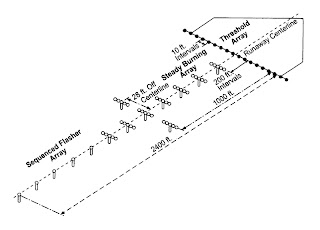
    That's the concept. Here's the reality: multiple ultra-powerful strobe lights mounted high on poles spaced even distances apart, flashing endlessly in rhythm every time the weather goes to pot. Each light structure has multiple bulbs, with each single bulb powerful enough to light up several football fields.

    The lights do point up into the sky and when it's clear they have nothing to reflect them back to the ground. However, when the fog or the rain comes in, the lights reflect off the mist creating an effect akin to repetitive lightning bolts.

    Now, imagine if these lights were only a few hundred feet from your house. Actually, I'll imagine it for you. Here's an animation of what it looks when I drive past there at night when it's IFR:


    You've already got noise and pollution. Now when you're trying to settle in to read a book on a stormy night, your windows are flashing like a nightclub lighting system on speed. Time to get some hotel-style "blackout curtains" I guess....
The Future

Now, what's in store for our intrepid homeowners? When I typed "Pensacola Airport Master Plan" into Google, it brought me to this page.

The two links on the top of the page discuss development within the airport's existing footprint. Both do not seem to affect the surrounding communities too much in their effort to improve the airport's facilities.
However, the red flag went up when I saw the link on the left labelled "Land Acquisition Program". If you're not familiar with the concept of eminent domain, it's time to look it up. Basically, the government has the right to take private property and use it for its own purposes. Normally this is used for public works projects, such as utilities, highways, and railroads. If the government decides it wants to run a highway over your house, it has every right to do so as long as it provides fair compensation for your property. Unfortunately for the homeowners, "fair compensation" is usually a lot less than what they were hoping for since, for all intents and purposes, their home is condemned.

The intent here is to build an Commerce Park that serves the airport. What's interesting is that Pensacola Airport has decided to be civil about it and is making it a voluntary process. Instead of tearing people's houses out from under them, they're letting the owners sell them on their own terms. Rather than grab all that real estate, it's being sold to the airport's owners one lot at a time.

How does this affect the house in question? According to the map of properties, this commerce park is just to the northwest of the airport, cornered by Tippin and Langley Avenues. This map also shows you which properties have already been purchased.

Where does the house lie?
Yup - it's just as close to the airport as the land being redeveloped. Based on what I'm seeing, I'm going to make an educated guess and say that within 5 or 10 years, the updated Airport Master Plan will have a provision for purchasing those lots to the northeast of the airport as well. I hope the new homeowners don't plan on staying there too long.

What Will Be

Buying a house is all about the potential of the space you're purchasing. Usually that means things like laying pretty wood laminate over that old vinyl floor, putting in new appliances while tossing out the old ratty ones, or simply putting up a new coat of paint to replace that nasty wallpaper. In a larger scope, you take a look at the neighborhood to see if your neighbors really take care of their houses and what kinds of developments are going on around you. Most people do that before they take the plunge, since they want to know what they're getting into.

But if you're buying near an airport, you owe it to yourself to protect your investment and research as much as you can. Pull your view even further back and look at your city's infrastructure as a whole to see how it could change over the next few years. Obviously the airport is a major part of that, but other public works projects like highways and utilities should be watched as well. Don't get trapped in a house that's both uncomfortable to live in and impossible to sell because you didn't take into account what the city had been planning for years.

Saturday, March 01, 2008

Musical Journeys

As I explained a while ago, I don't listen to the radio anymore. I go mostly for independent artists and, in general, music that's off the beaten path and remains raw and mostly untouched by the distortion of record corporation hands. My search for new music feels at times like a journey around the world as I discover new artists, new instruments, and new sounds from man different places.

Here are some of the artists that have been making their way on to my MP3 player. Warning: acquired tastes ahead. :)

Asian Dub Foundation
Our first stop takes us to England. This band has so many interesting elements and influences it's hard to categorize. Musically, they blend reggae, dub, electronica, breakbeats, ambient music, punk rock, folk music, and ethnic instrumentation. Lyrically, I feel they're almost on par with the cutting socio-economic and cultural commentary of Rage Against the Machine. And their basslines... man, I wish I could write basslines as groovy and melodic as theirs.
Rachid Taha
Now we cross the Mediterranean to Algeria. In an age where the popular media associates anything Muslim with terrorism and fundamentalism, here you have an artist that sings in Arabic about democracy, altruism, and religious tolerance. Taha's music is based off of traditional Raï music, but it incorporates modern instrumentation and rock/hip-hop styles to create something unique. If you've seen the movie Black Hawk Down you've heard his song "Barra Barra" as it plays near the beginning of the film as the U.S. forces are after the informant's convoy.
  • Barra Barra: Video / Translation- Live version of the song from BHD, which is a song about the effects of war and famine on a civilian populace. The word "barra" means "outside".
  • Ya Rayah: Music Video / Live video / Translation - A modernized version of a traditional folk song about the homesickness immigrants feel for their homeland.
  • Rock El Casbah: Video / Translation- Live cover of the Clash classic, including the Clash's guitar player
Musical Trivia: In the first two videos, the 8 string guitar-like instrument played by the guy standing stage-left is an Oud, a relative of the European lute. The hand-drum played by the sitting percussionist, also on stage-left, is a Doumbek (a variant of the goblet drum).

Nujabes
Mount Fuji's in the distance, so we must be in Japan now, home of this downtempo hip hop artist. He's most known in the states for the soundtrack to the excellent anime Samurai Champloo. The genre is "downtempo hip-hop" - basically, music with a nice beat that's easy to chill out to. Whether you're working, cooking, or whatever, his instrumentals and occasional vocal tracks make for some mood-enhancing background music.
  • Song of Seasons: Video - The end theme of Samurai Champloo. I love the flowing bassline in this song.
  • Feather: Video - A slideshow of Japan to his music.
  • Luv Sic: Video - Another slideshow set to his music.
Yoko Kanno
Yoko Kanno is one of the premier television and film composers in Japan today, with her talents for creating audio soundscapes in high demand. In the states, she's known mostly for her amazing soundtrack work for anime series such as Ghost in the Shell, Cowboy Bebop, Macross Plus, and Vision of Escaflowne. Whereas traditional composers such as John Williams and James Horner use mainly conventional orchestras to create their film scores (mind you, to great effect), Kanno uses anything and everything. In one soundtrack, she'll have pounding industrial anthems, gentle ballads, funky pop, militaristic themes, dynamic electronica, murderous fear music, and orchestral compositions. There's simply nothing the woman can't do well.

  • Rise: Video - The theme from Ghost in the Shell: Stand Alone Complex Season 2.
  • Inner Universe: Video - The theme from Ghost in the Shell: Stand Alone Complex Season 2.
VAST
We've crossed the Pacific and gone "feet dry" over the western United States. Jon Crosby formed his band VAST in the late 90's and had a couple singles make it onto the radio: "Touched" and "Pretty When you Cry". However, he fought with his parent company over his 2nd album's musical direction and was subsequently dropped from the record label after its successful release.
Stories like his are the reason I don't listen to the "compose by committee and focus group" music that's on the radio today. He dropped off the music industry's radar, but has continued to release new music under his own record label.
  • Touched: Video
  • Pretty When You Cry: Video - One of the creepiest videos I've seen in a while...
  • Free: Video
  • Take Me With You: Video - A happy cheery song. :)
  • Thrown Away: Video - LOL, he's packed on the pounds since his earlier stuff.

KHZ
Coming into land in New York City (hopefully La Guardia's got an arrival slot), here's a band that I've been following for a while.
They combine two of my favorite things: industrial rock music and a seductive female singer. :)

Thursday, February 28, 2008

Hotdogging

One of the controllers I work with is an avid skydiver and skydiving instructor. He's taken tons of people for tandem dives, giving them their first exposure to the fine art of throwing yourself out of a perfectly good airplane. :)

Well, he decided it was time for his dog to earn his wings! Check this out:

Monday, February 25, 2008

Tight Quarters

"Space is big. You just won't believe how vastly, hugely, mind-bogglingly big it is. I mean, you may think it's a long way down the road to the drug store, but that's just peanuts to space. "
- The Late Douglas Adams

One may think the same about the sky. Look up at it and you'll see a blue infinity with no boundaries, no barriers - just emptiness. Maybe a bird or two looking for an unwitting target for their digestive pyrotechnics, maybe a small cloud that wants to go grow up one day to be a huge cumulonimbus. Typically, though, it's a vast expanse of nothing but air.

However... throw a few planes in there and start looking at it through a radar scope, and things will change quite a bit. Then add a few more planes in there and point them at the first batch of planes. Finally... put imaginary walls up and try to keep those airplanes from smacking into those walls without permission. Now we're having fun!

We have nine sectors at our facility, the smallest of which - the "Z" sector - is approximately 10 miles by 10 miles wide (at its widest point) and reaches from the surface to a mere 3000 feet. It also has a corridor starting at about 3.5 miles wide that extends to the northeast directly into Eglin Air Force Base's airspace. The sector is designed to serve South Whiting Naval Air Station, otherwise known as one of the U.S. Navy's largest helicopter training bases.

While we do have other sectors that are about as small, those are only used for arrival sequencing into our other two airports. This is the only one that's consistently used for both arrivals and departures.

Here's what it looks like:


This sector can get very busy with IFR and VFR traffic arriving and departing South Whiting as well as multiple VFR aircraft operating out of Milton airport, right in the middle of the sector. Also, a majority of the Navy aircraft want multiple practice approaches to runway 32.

I created an illustration showing a fairly busy session on "the Z". Each circle represents the 3 mile wide circle around an aircraft, and each color is a different altitude: 3000 feet is pink, blue is 2200 feet, and 1700 is green.

Note: While the two "blue" VFR aircraft don't technically require the 3 miles, I left the circles around them so they're easier to see.


It's really interesting working this sector. While you deal with the same factors you deal with in other sectors - altitude, sequencing, approaches, etc. - you've got a lot less room to work with.

  • Altitude: The ceiling is a stratospheric 3000 feet and our MVA is barely over a thousand feet below it at 1700. When you're dealing with IFR aircraft, that means you only have have those two altitudes available if you want to maintain your 1000 foot vertical separation. If you have VFR aircraft, you've got a third for them: 2200.

    As with everything in ATC, you need to plan accordingly and use your "tools" wisely. As an example, inbound aircraft heading southwest will typically be handed off at 4000 feet, while your northeast outbounds will want to climb to 3000 or 5000. If you don't get your outbound climbing and your inbound descending quickly enough, they could feasibly fly into each other's face.

  • Lateral Separation: The main block of airspace is 10 miles at its widest point, and the "neck" stretching to the northeast is a little over 3 miles wide at its narrowest point. In short, you've got very little wiggle room for lateral separation. However, being that we're a terminal facility, we get to take advantage of terminal course divergence rules:

    5-5-7. PASSING OR DIVERGING

    a. TERMINAL. In accordance with the following criteria, all other approved separation may be discontinued, and passing or diverging separation applied when:

    1. Aircraft are on opposite/reciprocal courses and you have observed that they have passed each other; or aircraft are on same or crossing courses and one aircraft has crossed the projected course of the other and the angular difference between their courses is at least 15 degrees.

    2. The tracks are monitored to ensure that the primary targets, beacon control slashes, or full digital terminal system primary and/or beacon target symbols will not touch
    .

    In short: as long as the route of one aircraft is guaranteed to pass behind another or both aircraft have courses diverging by 15 degrees or more, we can have less than 3 miles of separation. Our friends over at the En Route Centers don't have that luxury.

  • Approach Requests: South Whiting is one of the two most-used airfields in our airspace for practice approaches. Its primary runway has ILS, GPS, RNAV, TACAN, PAR, and ASR approaches available for use by the South Whiting-based helicopters and the fixed-wing T-34s out of North Whiting. What's good about this is that it familiarizes you with the idiosyncrasies for each type of approach.

    You also learn to manage dissimilar aircraft in tight quarters using speed control and sequencing. For example: if you've got a helo 10 flying miles from the runway and a T-34 15 flying miles away, who will be first? Well, the helo tops out at about 100 knots whereas the T-34 cruises at about 180. It then becomes simple mathematics: while the T-34 has 50% more distance to fly, it's going 80% faster.

  • Frequency Management: The PAR and ASR approaches are two types of Ground Controlled Approaches (GCAs) both of which require an aircraft to be "talked down" to the runway by a Navy ground controller. Basically, they make a transmission every few seconds (5 for PAR, 15 for ASR) that fine tunes the aircraft's approach. I don't know the exact phraseology, but it's along the lines of "You're left of final... You're right of final... You're on course." The main difference between two is that ASR provides only lateral corrections, while PAR does both vertical and lateral. It's so accurate that a good PAR/ASR controller can talk a plane down in nearly any kind of weather conditions.

    Now, we obviously can't have a GCA controller talking on our main frequency for 2 minutes straight every 5 seconds. Therefore, when an aircraft comes in for a GCA we assign them one of 4 GCA-only frequencies that are used only for approach purposes. This becomes a complication when you have more than 4 aircraft coming in for GCA approaches. Now you need to keep track of who's on what freq, which freqs have cleared now that an aircraft has landed, who's not going to need a freq anymore because they're done with their GCA practice, and who hasn't been assigned a button yet.

    I won't go into the specifics, but suffice it to say it takes a combination of accurate stripmarking, datablock scratchpad entries, and situational awareness to keep things straight.

  • Borrowed Airspace: If you notice on the sector map, there are three areas to the southeast that are not shaded in yellow. These areas are owned by Eglin AFB, our eastern neighbor, but are usually on loan to us. However, they'll take them back several times a day and apply different separation rules to them. The most troublesome is the hot boundary. Translation: they'll be running IFR aircraft inside those airspace blocks right up to the boundary, so we need to keep our IFR aircraft a minimum of 3 miles away from the boundary instead of the usual 1.5. VFR aircraft are unaffected and can run right up to the boundary.

    Those areas are only given to us up to 3000 feet. If you've got an inbound from the northeast at 4000 feet who needs to go south to get to the final, you need to make sure he's at or below 3000 feet when he crosses that line into those areas. If he descends too slowly and crosses that boundary at 3500, you've just had a deal.

  • Hot Boundaries: Now go back and look at the map. You'll see that Whiting's runway final depiction runs right into those areas I just mentioned. However, the approaches are designed to have a dogleg that runs nearly north/south, starting about 5 miles out from the airport. But...that dogleg is less than a mile from the boundary!

    What this boils down to is that we cannot give IFR aircraft any approaches if the boundary is hot. We usually have to tell the pilot something along the lines of "Navy123, the restricted areas have gone active. In order to continue with this practice approach you will need to cancel IFR." The Navy pilots are familiar with this situation and will usually comply. The weather around here is typically good and it's usually a non-issue.

    As a contingency - in the case of a combination of true IFR conditions and a hot boundary - we do have a separate helicopter-only TACAN approach that runs north/south a mile west of Milton airport. The fixed wing aircraft have their own full TACAN at North Whiting.

  • VFR Pop-ups: Milton is a very busy little uncontrolled training airport, to the point that on some days we feel like calling ourselves "Milton Approach". Overall, the Cessnas and Pipers that come off there are pretty innocuous and they usually take care of themselves. We issue traffic calls and altitude restrictions as needed to keep them informed of the swarm of Navy traffic around them, but they pretty much stay out of trouble.
  • My one pet peeve is the following: inevitably, when I've got a busy pattern full of Navy helos and T-34s, a student pilot will call up, "Pensacola... approach....Warrior 1...2..3...4........5... Off Milton at.... 1000 feet... uh...Five miles south of... uh....Milton. Request....requesting flight following to... the beach... the beach practice area."

    Now, I'm a pretty fresh private pilot. Mic fright sucks. I've had it. I still have it. I can relate and I'm in no way angry at them. But man... they always pick the worst possible time to call! However, considering the tight nature of the sector, by the time they're done one Navy guy's blown through final, another Navy guy's missed his turn, and yet another's about to run into another sector. Now I'm playing catch-up, calling out point-outs to other sectors and Eglin, and the whole plan needs to readjusted.
Overall, a lot can happen in a little bit of airspace. I'm sure there are hundreds of other sectors like this out there in other facilities. However, it was a pretty blunt shock coming from the Academy - where you've got all of two massive sectors 50 miles wide - to working a crowded piece of airspace that's about as big as my backyard. :)

Of the three sectors I'm training on, it's physically the smallest but by far the most challenging. But when you get it running smoothly, it feels really good.

Thursday, February 21, 2008

Eagles Down

This happened right next door to us:

Air Force: 1 pilot dies, another survives after F15Cs collide

The initial report we got was that one of our T-6 Texan II's from NAS Pensacola went down. We work with the T-6 students and instructors every day, so we were pretty worried when we heard this. There was a lot of Coast Guard activity and SAR stuff going out there.

Turns out that, instead, it was two USAF F-15's from our neighbors at Eglin AFB. I'm bummed that one of the pilots didn't make it.

It reminded me of this video I saw on YouTube a while ago, which is pretty freakin' scary. Both of these pilots survived:

Tuesday, January 22, 2008

Life on Data

I got checked out on Flight Data 1 & 2 a couple weeks ago.

Flight Data seems to be where most people start out in most facilities. Here, I started on radar first and then trained on flight data several times a week in between radar sessions. I don't think there's anything wrong with either approach, since they compliment each other. Working radar teaches you the operation and how everything fits together, plus allows you to see why you need to do certain things when you're working Data.

Flight Data always gets treated condescendingly as a position. You don't talk to any airplanes and you're basically doing the "paperwork" for everyone else who is talking to airplanes. However, it's a vital position that is designed to allow those working radar to focus on their traffic rather than dealing with weather data and NOTAMs.

Now, doing a good job on flight data will not actively relieve the stress of the different radar positions. However doing a bad job will complicate the rest of the room and pour on the stress.

One of my coworkers put it quite eloquently, "On flight data, you can't keep the room from going down the shitter, but you can sure send it there in a hurry!" :)

For those that don't know, the basic role of Flight Data is to:
  • Run flight data strips to different positions.
  • Update the weather and information displays.
  • Correct and follow-up on defective flight plans.
  • Amend, create, and remove flight plans.
  • Collecting traffic strips and papers for counting.
Here's a quick overview of how it works:

1) Departing Aircraft:

We have three Class C airports within our airspace, and we maintain a separate strip bay for each to keep things organized. When a particular aircraft is on the move, the tower will call our Flight Data position to activate the aircraft. We then take the strip(s) to the appropriate scope working that airport so they have it in front of them.

2) Arriving or En Route Aircraft:

For aircraft transiting or landing in our airspace, we'll post the strip in the strip bay next to the radar scope sorted by the time they're supposed to arrive in our air space. Sounds easy, right? Not necessarily. There's a lot of "educated guesstimation" going on there. You have to be very aware of your airspace, your operations, your letters of agreement, and the positions that are open.

Here's an example:


Call sign: Navy 123
Type: T-1 Jayhawk
Departed: Naval Air Station Jacksonville
Arrival Fix: Crestview VOR
Destination: Naval Air Station Pensacola
Direction of flight: Southwest
Arrival Time: 0800
Call sign: Navy 456
Type: T-6 Texan II
Departed: Naval Air Station Jacksonville
Arrival Fix: Crestview VOR
Destination: Naval Air Station Pensacola
Direction of flight: Southwest
Arrival Time: 0800

Aside from the type of aircraft, both are identical right? Both strips will show the same thing, the same fix, same destination, etc. However... the type of aircraft changes everything; the T-6's are turboprop trainers, the T-1's are jets. Per our Letters of Agreement (LOAs), Navy jets always come in high, overfly the rest of our airspace, and go direct to the NAS Pensacola sector. The props always come in lower and have to go through our other sectors before eventually arriving at NAS Pensacola.

So, as far as strip posting for our example, Navy 123 would go directly to the NAS Pensacola sector. On the other hand, the Navy 456 would go to our lower-altitude East sector.

Basically, the devil is in the details. After a while, you're able to look at a strip and quickly determine where it's going and get it there. You'll recognize patterns that will make things second nature. However, even after a while, there are still strips - usually unscheduled GA traffic whose course puts them right on the line between several sectors - where you'll have no idea as to where they'll go. In those cases, you just take your best guess and post it on the scope where it's most likely to go. Even then, you've got about a 50/50 chance of hearing someone call out "Anybody got a strip on a N12345?" :)

3) Flight Plan Management

ATC is a dynamic operation and all things are subject to change, including what's written on a flight strip. Reasons for modifications are numerous:
  • Modifying an en route aircraft's altitude so that the receiving facility knows what altitude to expect him at.
  • Adding a fix in other facility's airspace to a flight plan so that it will hand off to that facility correctly.
  • When an aircraft whose flight plan takes it to another facility decides to cancel radar services, you'll need to "Remove strips" on that aircraft. This deletes the flight plan from the National Airspace System and informs any facilities along his route of flight to throw away all strips related to that aircraft. If you don't remove the strips on that aircraft, you'll be getting phone calls asking about that airplane wondering where he is and if anything happened to him.
Working on Flight Data, you'll find out really quickly that our National Airspace System has tons of quirks. It's very, very particular about how it wants its information, and even when you input it correctly there will invariably be moments when you are staring at the screen, looking at the feedback, saying to yourself "What the hell?"

My one word of advice: Whenever you go Oklahoma City to train, become real familiar with the FDIO (Flight Data Input-Output computer). Pay attention during that lesson. Learn the fields and learn the formats for amendments, because you will be using them frequently.

4) Weather and Information

The last of your major duties is to - put simply - disseminate information of all kinds related to the operation and update the information on this screen. There's one of these screens over each radar scope and from the Flight Data position you can update the data on all of them simultaneously.

(BTW, check out that low ceiling!)

Typical information:
  • Weather/ATIS: While our main airport updates its weather and ATIS automatically, we get manually-sent weather reports from the other two Class C's in our airspace. This gets a funky sometimes because the airport's weather department will send you new weather but the tower will still be using the old ATIS code. We have in-house procedures for when that happens - namely putting a highly advanced asterisk next to the ATIS code when the ATIS is old but the weather is new. :)
  • MOA Activations: When areas go hot, it affects our routes and approaches, so it's vital to get that info up there.
  • NOTAMs: Various NOTAMs for both towered and uncontrolled fields throughout our airspace. Examples include unavailable approaches, closed runways, lighting outages, and navigation aid outages.
  • Flow Control: Our flow with our two neighboring centers and two approach controls changes frequently, so that needs to be updated. We have two main settings: Gates and Randoms. Gates means that aircraft going to another facility need to be routed through one of our arrival/departure gates. Randoms means you can put the aircraft through any part of the airspace boundary between both facilities.
Well, that's an overview of Flight Data. It's one of those positions where you'll have your feet up one second, and the next you'll be literally breaking a sweat as you're running strips all over the room, inputing amendments shouted at you from around the room, and stuffing piles of strips coming out of the printer. Not very glamorous, but certainly very important to the operation.

Thursday, January 17, 2008

Back from the dead

I'm really sorry I haven't posted in a while. Believe me, it's not for lack of material. I've just had a lot going on in my life over the past month or so,.

Here's the breakdown:
  • We finally found a house we wanted to buy, after 8 months of searching.
  • We had to jump through an enormous number of hoops to get this house. It's our first home, so all of the inspections, the paperwork, shopping for mortgages, comparing insurance companies, etc were new to us and very tiring.
  • We had to pack up everything in the apartment we'd been renting.
  • The holidays came and went, bringing along with them their own set of complications, as we went back to Miami to visit our families.
  • We closed on the house on Dec. 28th.
  • We moved into the house over the weekend before New Year's.
  • Every bit of free time we've had since we got the house has been spent working on getting the house setup as we want it. New appliances, new furniture, etc.
  • I've been setting up a garage work shop so I can Do-It-Yourself things around the house. I bought all kinds of dangerous toys like saws, drills, and Dremel tools. :)
  • On top of that, we had no internet for several weeks, and I can't access Blogger from work.
I gotta say, it's wonderful being able to own your home and not throw away money in rent. We were very lucky in being sent to Pensacola. I've heard horror stories from friends of mine who were sent to places like Nantucket and Southern California and are trying to get by on the AG payscale. Not one of them has been able to survive without help from their families. For several of them, 75% of their salary goes to just rent. If you're taking home $2300 a month ( AG salary including standard 12.52% locality), and your rent is $1600, there's simply not much breathing room for car payments, insurance, utilities, phone, car, food etc..

Down here, home prices are excellent compared to what I'm used to. In Miami, a comparable house to the one we bought would have been priced three or four times as much. We simply would not have been able to afford anything.

Put it this way: my best friend in Miami recently bought a 1/1 apartment in an older condo-conversion subdivision in a mediocre area of town. It's around 600-700 square feet, has a dinky kitchen, and was in fixer-upper condition. He had to put in a lot of money into updating the bathroom and living room, and the place still looks kind of dreary.

Our house is a 3 bed/2 bath detached single family home with 1620 square feet, a 2 car garage, and a huge corner lot. We have a covered porch, 15 foot high ceilings, a beautiful kitchen, and tons of storage. Our neighborhood is very pretty and quiet, with lots of kids and people out jogging. We're 10 minutes from my work and 15 from Mary's, and if you sit out on the front porch you can watch the approach traffic on the glide path into our main runway, beautifully lit by the afternoon sun.

The kicker? We paid $20,000 less than my friend did for his 1/1 condo.

On top of that, we have no traffic jams here, people are very nice, everything is close, and the city is overall very pleasant. The nightlife is no South Beach, but at the same time everyone here is more down to Earth and real. There's plenty to do and see. Whenever we have kid(s), the schools here are some of the best in the state.

The moral of the story is this: if the FAA assigns you to some strange airport in the state of your choice, do your research. Visit the city, visit the facility, familiarize yourself. Don't blow it off. What you think may be some podunk tower in some backwater town may just be exactly what you've been seeking. I would never have thought I would like Pensacola, but I find that I'm really liking the way of life down here.

Saturday, December 08, 2007

Living History

I love airplanes. I enjoy seeing them, reading about them, flying them, visiting a museum full of them, and generally being around them. No matter the shape, size, purpose, or model, I'm a fan. One of these years I'd maybe like to own one, like a sporty Vans RV series (200mph + full aerobatics = wooHOO!) or even something as basic as a Cessna 172. But that's far into the future.

As I train, I'm of course talking to a variety of aircraft on a daily basis. Since the sectors I'm training on are low altitude (surface to 5500') all of the airliners, corporate planes, and jets pass overhead at 6000-10000. The majority of aircraft I work are Navy T-34s and H-47s, plus a few Cessnas and Pipers. We also get the Navajos, the Cirrus, the occasional Columbia, and other GA types that are passing through. I've talked to enough of these that, while not exactly "routine", they've become "regulars" whose patterns you recognize well.

However, every once in a while, I'll talk to an aircraft that'll bring out the airplane fan in me and put a smile on my face.

Two days ago, I was handed a strip for a N18P. He was traveling eastbound and I didn't recognize the aircraft type. "AA5" or something like that. I take the handoff and see that he's cruising at 200+ knots. He checks on, I give him the altimeter, and ask him his aircraft type.

He responds "Grumman FM-2 Wildcat".

A little history lesson: The Wildcat is a WWII aircraft carrier fighter that was featured in every theatre of the war - Pacific, North Atlantic, European, etc.. It was not the fastest, nor the most maneuverable, nor the most heavily armed fighter of the war. Its opponents like the Japanese Zero were much more maneuverable. It is often forgotten in lieu of flashier aircraft like the P-51 Mustang or the P-38 Lightning. Compared to the sleek F-4U Corsair or the massive P-47 Thunderbolt, it's a tubby little barrel of an airplane.

However, it is the quintessential "unsung hero" of the war, especially the war in the Pacific. In the battles of Midway, Coral Sea, Santa Cruz, and others, it protected American dive dombers and torpedo planes as they struck again and again at the Japanese naval fleet. In the Atlantic, it served aboard light escort carriers, conducting patrols and protecting convoys from the ubiquitous German U-boat threat and German airpower. In England, it became the first American-built aircraft in British service to score a combat kill.

The Wildcat had a large list of pros and cons. The Wildcat's hand-cranked, narrow-track landing gear made carrier operations very treacherous. On the other hand, while outperformed by the Zero, it could take far more damage thanks to its construction and self-sealing fuel tanks. Zero pilots could pour hundreds of rounds into a Wildcat and still not bring it down, whereas a few shots into a Zero would cause it to burst into flame. The Wildcat was simply able to bring its pilots home safely. As an example of the overall success of the design, Wildcat variants were produced from 1940 up until the final days of the Pacific war, even after more powerful replacement aircraft such as the F6F Hellcat had been introduced.

I had no other traffic at that point, so I talked with the pilot a few times. "Is that the one with the hand-cranked landing gear?" I could hear him perk up when he realized I knew exactly what he was flying. "Sure is!." I found out he was based at the Cavanaugh Flight Museum located in Texas. "Do you give rides?" I asked, hoping that maybe they'd modified it into a two seater like some P-51 owners had. "Only got one seat," he said, laughing. They apparently perform at air shows around the country. "I'd love to come here [Pensacola] for an air show," he said. "You're welcome anytime." I replied. He sounded like he was having a great time in that war bird. Eventually, I handed him off to Eglin AFB's controllers with a parting "Have a great flight."

It was just cool. I really enjoy history, and definitely appreciate the efforts of those who want to keep history alive. It's one thing to see a photo on the web or words in a book. It's quite another to see the real thing, engine roaring, pilot lifting it into the sky, giving modern audiences a taste of what aviation was like back then. Even when the folks who flew them into battle are gone, at least we'll have their machines to bring those lost stories to life for generations to come.

Some pics of the Wildcat, then and now.

Wildcat taking off from the USS Ranger.
Wildcat formation.

N18P taxiing.
N18P in flight.